


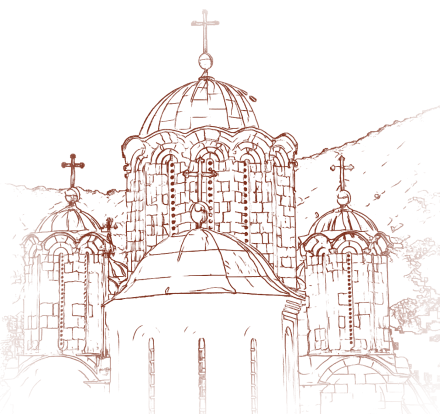
The zealous monks of Manasija, however, restored the monastery and raised it up anew. During the 19th century the monastery again became active - it became the home of a monastic community, which for its part worked diligently on the restoration of the monastery. These restorations, however, carried out during the first half of the 19th century, were modest in scope. In a country exhausted by centuries of bondage and still not truly liberated, there were neither the conditions nor the means for any more thorough restoration. While the restoration was slowly being carried out, some authors who looked upon Manasija were left in admiration, while to other observers the ruined appearance of the holy place was a source of grief and distress. Thus Atanasije Nikolić (1803–1882) described the poor condition in which the monastery found itself. In a text he published in 1841, he expressed his concern for the monastery, lamenting that more was not being invested in Serbia in the care of cultural monuments, criticizing the lack of understanding of the significance of the Serbian historical heritage, the negligence and passivity, and calling the nation to collective responsibility. Through a survey of the history of Manasija Monastery, he reminds his readers of the glorious times of the Nemanjić state. At the same time, his description also offers important information. Nikolić records that the Manasija Church of the Holy Trinity leaked in Karađorđe's time, that the whole roof, including the dome, was then re-covered and restored by Prince (knez) Milija Zdravković (†1814), and that when, twenty years later, it began to leak again, it was re-roofed by his son, the oberknez Milosav Zdravković Resavac (1787–1854).77 The poor condition of the Manasija church is also attested by the report, dated December 7, 1839, of the commission that Prince Miloš charged with inspecting the condition of the monasteries and churches in the Principality of Serbia of the time, which says of Manasija: "This monastery is inside in an altogether bad state and dangerous for people, since stones are continually falling from the whole vault, so that the brotherhood and the people are in great danger when holding the divine service, and it leaks a great deal, for which reason the templon too, which is already finished, cannot be put in place until the whole monastery is re-roofed and those places from which the stones are falling are repaired."78 The letter of Samuil Janković, superior of Manasija Monastery, which he sent to the Metropolitanate in Belgrade on August 3, 1842, likewise depicts conditions in Manasija at the time. The hieromonk Samuil reports to Metropolitan Petar Jovanović of Belgrade (1800–1864) on the condition of the monastery church as follows: "It is known to Your Eminence that this holy abode is in a poor state, and how from time to time it crumbles ever more and draws near to collapse. This state of its collapse formerly showed itself to a lesser degree, and it could be helped more or less, but behold, now it has become more frequent, and I fear that, if it grows worse, the church will be ruined altogether. Some time ago a large stone fell out of the middle of the vault above the iconostasis, and others beside it are ready to split, and after these heavy downpours, since the vaults have become greatly soaked because of the poor roofing, on the north side, before the north door, in the middle of the vault, right at the center of the domed height of the vault, a round piece an arshin in size broke loose and fell down. This cavity becomes ever larger and more dangerous through many smaller and larger pieces of stone from the vault, and if help is not brought as soon as possible, it will not be possible to perform the necessary divine service without great danger."79 From the testimonies cited it may be concluded that the restorations of the church carried out during the first half of the 19th century were more in the nature of mere repairs, which could secure neither the church nor the safe performance of divine services.
- Atanasije Nikolić, "The Monastery of Manasija" („Мoнастиръ Манасиiа"), Supplement to the Srbske novine (Додатакъ къ Србскимъ новинама), year 2, no. 22 (June 7, 1841): 87–88; cf. Radosavljević, The Orthodox Church in the Belgrade Pashalik, 1766–1831 (The Administration of the Ecumenical Patriarchate), 397–398; Ivana Ilić Kiš, The Life, Literary and Theatrical Work of Atanasije Nikolić (1803–1882) (Живот, књижевно и позоришно дело Атанасија Николића (1803–1882)) (Novi Sad: Serbian National Theater, 2021), 136–137, 154.
- Cited from: Milan Đ. Milićević, "Monasteries in Serbia" („Манастири у Србији"), Glasnik of the Serbian Learned Society, vol. IV, no. XXI (old series) (1867): 1–96: 88. The templon mentioned in this report is the iconostasis, probably the one later moved to the Church of Saint Nicholas in the village of Dvorište, which was painted in 1825, on the commission of abbot Sava Popović, by kir-Kostadin and kir-Giorgi from Grabovo in the nahiye of Trnovo - cf. Tomić and Nikolić, Manasija: History - Wall Painting, 34, n. 95.
- Cited from: Stevan S. Tomić, "Archival Documents on the Conservation and Restoration of Manasija Monastery in 1844," Zbornik zaštite spomenika kulture, vol. II, no. 1 (1951): 13–30: 15; cf. also Tomić and Nikolić, Manasija: History - Wall Painting, 34.