


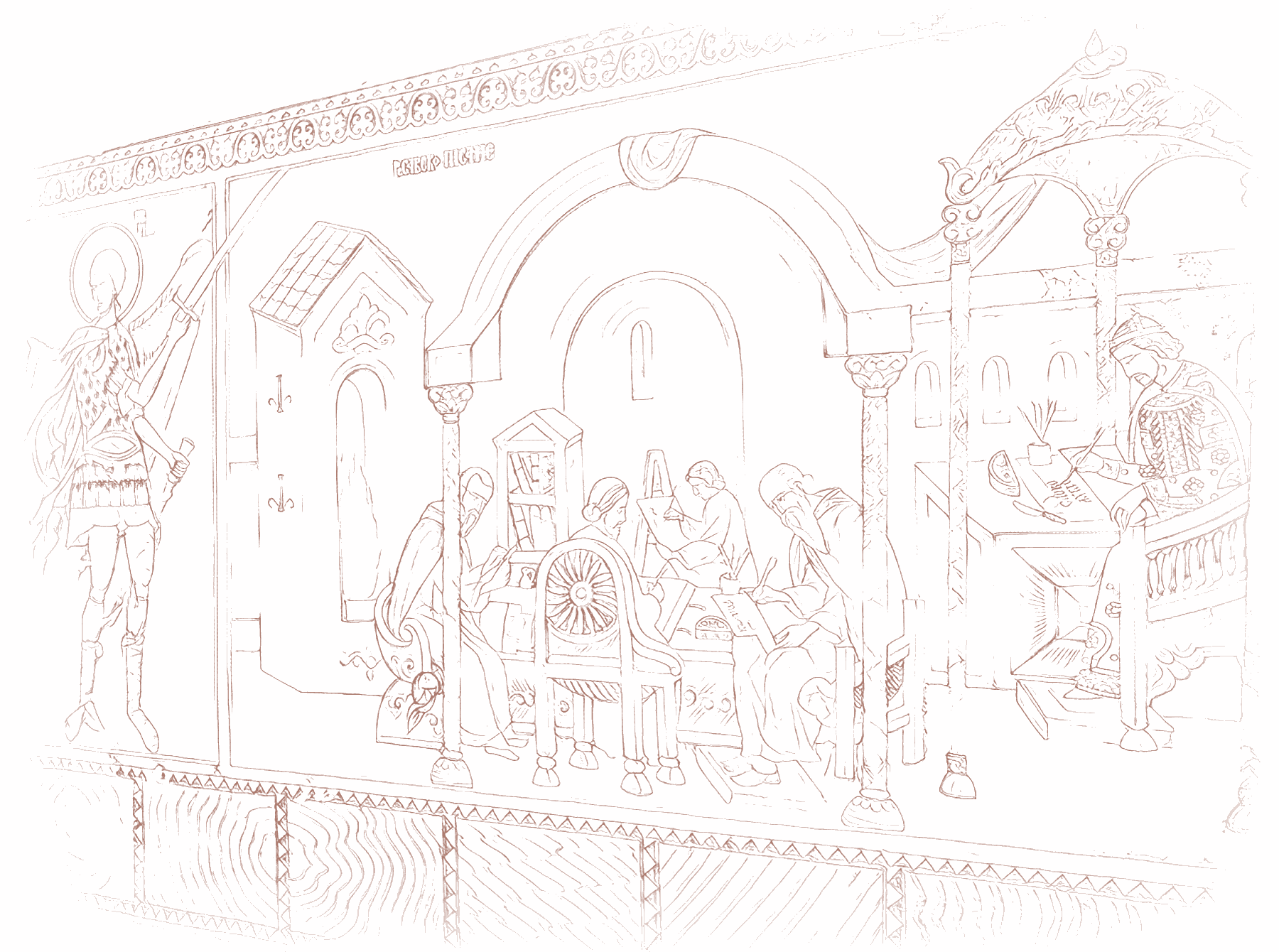


But Despot Stefan was not a visionary in words alone - by his deeds he built a new world. He raised churches, protected men of letters and artists, opened schools and shelters for monks and thinkers fleeing before the Turkish onslaught. Like Stefan the First-Crowned of old, he too was a wise ruler who, despite the wounds of his time, succeeded in lifting up the Serbian people, renewing art and laying the foundations for the future of the written word.
In the aforementioned Hilandar charter, Despot Stefan Lazarević offers thanks to the Lord that, despite all trials, even those that lead to death, he was granted the strength to renew his land and lead it on the path of salvation. Consciously bearing the burden of his time, he prays God to punish all who would dare to destroy his labor and ruin what he had raised with great love and self-sacrifice. Like his glorious forebears, he too looks toward the Age to Come, reflecting on the suffering that may befall a man whose life is filled with sins. Nor does he forget the sins of the past, which led to the fall of the Serbian Empire and the Turkish invasion. Therefore in his charter he addresses a plea to all who will care for the monastery in the future, whatever their origin, for it may happen that a ruler comes, as he says, "because of our sins, foreign to our race." He adjures them in the name of Christ not to allow what has been granted to the monastery to be destroyed, that is, that the monastery and its estates be preserved.
A similar plea - but also a curse - he pronounces in the Charter to the monastery of Mileševa. Whoever dares to ruin or alter his work, may God Himself, he says, destroy him, and instead of protecting him may Saint Simeon and Saint Sava be his adversaries, both in this world and in the next.
As in his other literary works, in his charters Despot Stefan often quotes Holy Scripture, and still more often alludes to the biblical text. Among the biblical books he cites, a prominent place is held by the writings of the Apostle Paul - the Epistle to the Romans and the Second
Epistle to the Corinthians, as well as the Gospels according to John and Matthew, and the Book of the Prophet Isaiah - all in the charters addressed to the monastery of Hilandar; in the Charter to the monastery of Saint Panteleimon of 1395 he likewise cites the Epistle to the Romans, the Gospel according to John, and the Psalter of King David; the Proverbs of Solomon in the Charter to the monastery of Mileševa; in the Charter to Despotess Jevpraksija he quotes the Gospel according to Matthew and paraphrases the Psalter; allusions to the Psalter are also found in the Charter to the monasteries of Tismana and Vodica, as well as in the charters to the Great Lavra, in which, besides the Psalter, Despot Stefan also cites the Book of Exodus, the Proverbs of Solomon, the Gospel according to Matthew and the Second
Catholic Epistle of the Apostle Peter, paraphrasing the Gospel according to Matthew, the Gospel according to Mark and the Gospel according to Luke, and alluding to other biblical books as well; the Charter to Vatopedi cites formulations from the works of the Holy Fathers and from the services of the Orthodox Church, but also the Psalter and the Revelation of John, along with paraphrases of the Gospels according to Matthew, Mark and Luke.
As regards quotations from Holy Scripture in the literary works of Stefan Lazarević, the Homily on Love is a catena of biblical verses, allusions and images: these facts