



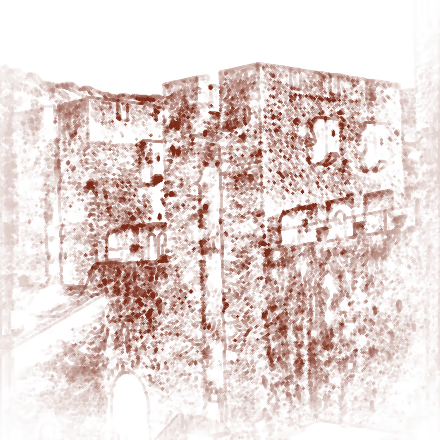
Coming again and again to the monastery that always drew his attention, Felix Kanitz describes in his notes what monastic life in Manasija Monastery looked like around 1888: "The archimandrite [Kiril], 3 monks and the pupils live in a modest lodging leaning against the rampart of the fortress; pictures, geographical wall maps, books and portraits of the two Serbian princely families, of metropolitans and others bore witness to the loftier spirit and well-known love of art of the late Archimandrite Evgenije. In the rooms of the lodging the tradition of Serbian hospitality was maintained in full measure. Rising is very early, for already at 3 o'clock in the morning the bell calls the monks to morning prayer, the second rings around 5 o'clock, and the third and last in the evening; during the day the monks and pupils do the work in the house and in the fields."144 Kanitz also describes the precious Gospel and the sumptuous cross that adorn the altar table,145 imperial gifts that came to Manasija from Russia in 1857.146 A description of these treasures of Manasija was also left by Slavka J. Kuzmanović: "The archimandrite [Kiril] invited us to follow him so that he could show us the Gospel and the cross that the Russian Empress Maria Alexandrovna had given to the monastery. The Gospel is very large, the covers are of gold and platinum, a centimeter and a half thick, with various images engraved on them. The cross is of gold, and the Crucifixion of Jesus is depicted on it. The Gospel and the cross are worth five thousand Russian rubles. This is an imperial gift."147 The epoch in which the Serbian state was restored during the 19th century was, compared with the period of medieval Serbian statehood, in every sense an epoch of poverty, want and scarcity. Again, the time when abbot Kiril held the position of superior of Manasija was for Manasija a time of devoted monastic labor, but, thanks precisely to that labor, also a time of restoration and building of the monastery. In the Church of the Holy Trinity, a large wooden iconostasis was made and painted. It was painted by Milija Marković and his son Nikola from Požarevac; the iconostasis was completed in 1864. The monastic community lived in the old monastic lodging; keeping it meticulous and clean, it received guests from every side, from the surroundings but also from distant foreign lands. Notes on the appearance and furnishing of the lodging in this period (around 1890) were left by Slavka Kuzmanović: "On the left side as you enter the courtyard is the church, and on the right a two-story house in which the monks live... The monastery looked even more beautiful from the window upstairs, when we went up into the house. The house is very beautiful, comfortably furnished... On the upper floor there are five rooms. I was surprised by such cleanliness and orderliness in the monastery. The rooms are all painted, the beds clean, the walls full of pictures... There were books there, and pictures, and visiting cards..."148 Books had been present in Manasija Monastery from its very beginnings in the time of Saint Despot Stefan, but also in times of want, during the 18th and the 19th centuries. Monastic life in the Resava monastery was always bound up with the book, with literacy and the written word. In the second half of the 19th century a monastery library had already been formed. Again, pleasant and difficult moments alternated. The monastery was damaged in an earthquake which, according to the words of Archimandrite Kiril, recorded by yet another guest of Manasija, the Russian writer and travel writer Yevgeny Markov (Евгений Львович Марков, 1835–1903), occurred on the eve of Easter 1893.149 For the repair of the church and other buildings of Manasija Monastery, the Serbian state allocated 10,000 dinars in 1894.150 The following year, in yet another restoration, repairs were carried out - the crack in the church and the damage caused by the earthquake were remedied, and the repair is attested by a slab with an inscription that is today located high on the western façade of the Manasija church: "Repaired 1895 under the reign of H. M. Alek[sandar] I. S. M. Kirilo" (Оправка 1895. под владом Њ. К. В. Алек[сандра] I С. М. Кирило) ("S. M." before Kiril's name in the inscription probably stands for "smireni monah," "the humble monk").
- Cf. Feliks Kanic, Serbia. The Land and Population from Roman Times to the End of the 19th Century. Vol. 1 (Србија. Земља и становништво од римског доба до краја XIX века. Књ. 1), translated by Gligorije Ernjaković (Belgrade: Srpska književna zadruga - Rad, 1985), 277–278.
- Cf. Kanic, Serbia. The Land and Population from Roman Times to the End of the 19th Century. Vol. 1, 277.
- Cf. I. E. [= Evgenije Simeonović], Description of Manasija Monastery, 20.
- Cf. Stanković [Kuzmanović], "Remembrance of an Unknown Poet (Conclusion). The Road to Manasija Monastery," 373.
- Cf. Stanković [Kuzmanović], "Remembrance of an Unknown Poet (Conclusion). The Road to Manasija Monastery," 372.
- Cf. Yevgeny L. Markov, "In a Brotherly Land. Travel Sketches of Serbia: 10–12 (Conclusion)" („Въ братской землѣ. Путевые очерки по Сербiи: 10–12 (Окончание)"), Russkiy vestnik, Year 43, Vol. 258 [No. 12], December 1898 (1898): 36–67: 58–59; Yevg[eny]. Markov, A Journey through Serbia and Montenegro. Travel Sketches (Путешествiе по Сербiи и Черногорiи. Путевые очерки) (Saint Petersburg: Tipografiya M. Stasyulevicha, 1903), 159. Cf. also the brief newspaper report on the damage to Manasija Monastery in the earthquake: "News from Home and Abroad. Manasija Monastery" („Вести из места и са стране. Манастир Манасија"), Zastava: Organ of the Serbian National Radical Party, year XXVIII, no. 60 (Tuesday, April 20, 1893): 2. Markov also described the Gospel that came to the monastery as a gift from imperial Russia in 1857. From his notes we learn that at the end of the 19th century the Manasija lodging was clean and orderly, nicely furnished, and that the monastery had a Visitors' Book: cf. Markov, "In a Brotherly Land. Travel Sketches of Serbia: 10–12 (Conclusion)," 63–64; Markov, A Journey through Serbia and Montenegro, 165–166.
- Cf. "Manasija Monastery" („Манастир Манасија"), Zastava: Organ of the Serbian National Radical Party, year XXIX, no. 112 (Tuesday, July 19, 1894): 2.