

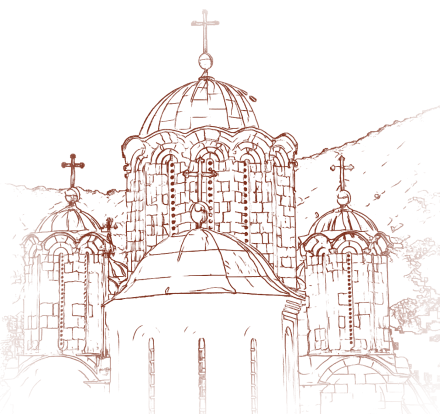
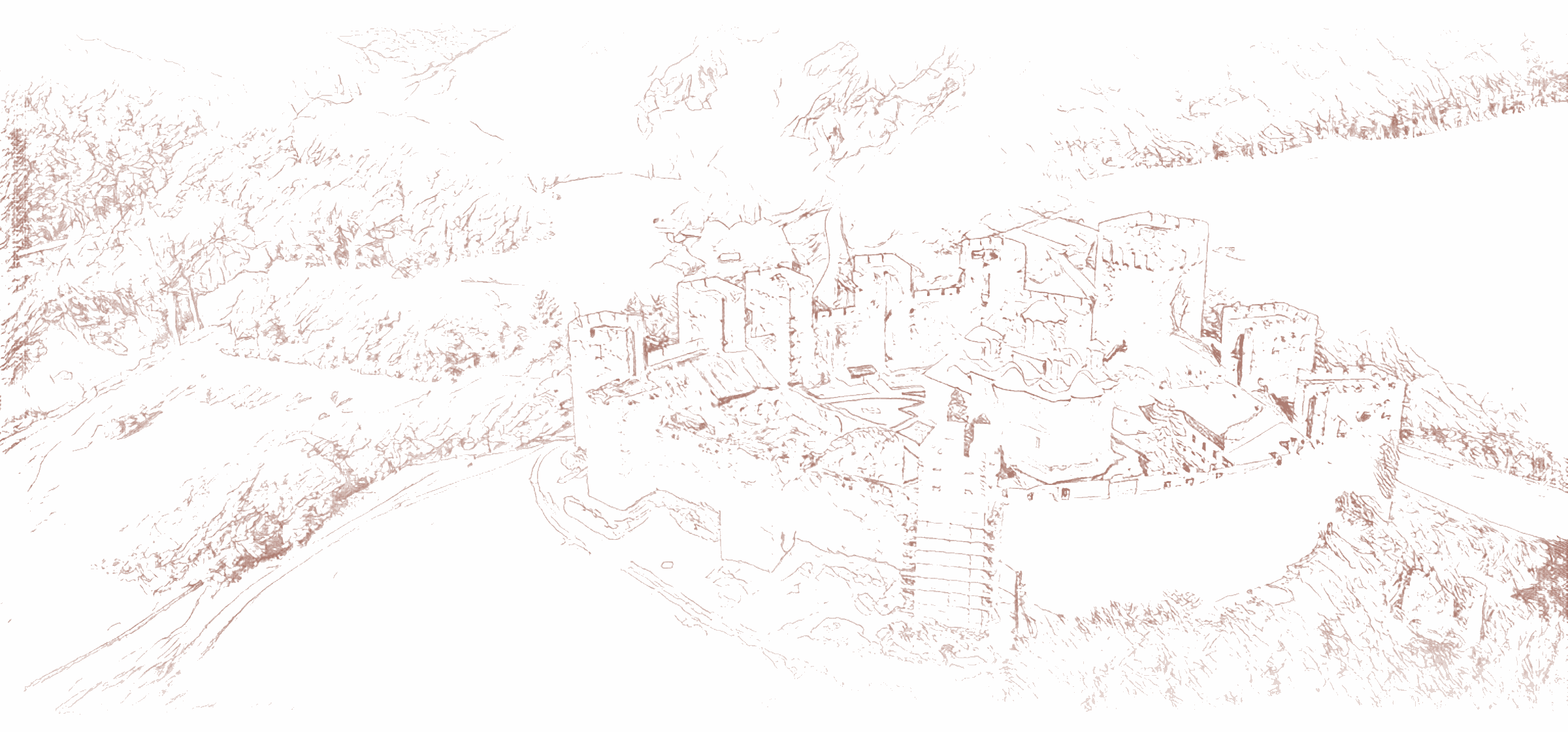
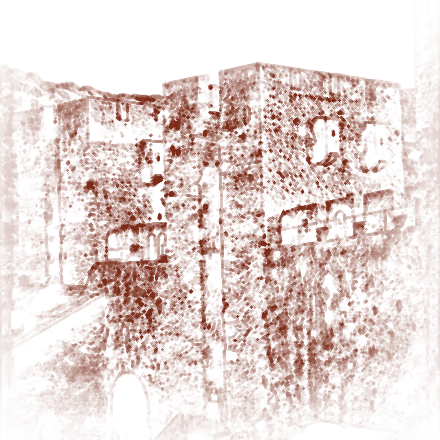
Not long after its founding, the activity of the monastery of Resava became renowned far and wide, not solely for the monastic life of its inhabitants but also for its considerable cultural and scholarly influence. Ascetic life flourished in the monastery - monastic hermitages have been discovered in caves in the immediate vicinity of the monastery, and judging by the surviving records and archaeological finds, in the first half of the 15th century there was a large number of churches, monasteries and hermitages in the surroundings of Manasija Monastery,6 which suggests that the monastery itself had become the center of spiritual life. The monastic community was made up of learned and diligent monks, and through the efforts of Despot Stefan, and by way of the copying, translating and literary work of the monastic brotherhood, Resava developed into a cultural hearth in which the famous Resava School was active. Despot Stefan Lazarević reposed in 1427 [ŽDS 86], and according to his wish he was buried in his endowment [ŽDS 87], that is, in the monastery's Church of the Holy Trinity, as his biographer Constantine the Philosopher (c. 1380–1431), the author of the Life of Despot Stefan, testifies. Somewhat later, in 1438 to be exact, Kalojan Rusota was buried in the narthex of the monastery church, as recorded in the Sečenica and Branković Chronicles [SRL 85: 5–8; SSRL 652, 1147; SLDĐ 20; BL 53].7 The famous Resava School flourished during the final years of Serbian medieval statehood and gained great renown. The influence of this school was felt not only in the Serbian lands but spread further: according to assessments found in the literature, this influence reached as far as Russia, Romania and Wallachia, the southern lands and Mount Athos, while it was especially pronounced in Bulgaria. This school established high orthographic, literary, linguistic and translation standards, so that the copies and translations produced in it served as models in the centuries that followed. The monastery of Resava grew, expanding its renown and influence.
- Cf., e.g., Stanojević, Bošković and Mirković, Manasija Monastery, 31.
- According to the Branković Chronicle, Rusota reposed in 1436, while the Sečenica Chronicle gives the date of Kalojan Rusota's repose as April 16, 1437; Mihailo Dinić established that this event should be dated to the same day in 1438; see Mihailo J. Dinić, On the History of Mining in Medieval Serbia and Bosnia. Part II (За историју рударства у средњовековној Србији и Босни. Део II). Serbian Academy of Sciences. Special Editions, vol. CCCLV. Department of Social Sciences, vol. 41 (Belgrade: Naučno delo, 1962), 89; see also Miloš B. Ivanović, "The Nobility of the State of the Serbian Despots" („Властела државе српских деспота") (doctoral dissertation, University of Belgrade, Faculty of Philosophy, 2013), 315. It is not entirely certain which Kalojan Rusota was buried in the Resava church; according to Božidar Ferjančić, in the first half of the 15th century at least two men of that name lived in Serbia: the customs official of Novo Brdo, who is mentioned in the sources until 1445, and another Kalojan Rusota, who reposed in 1437. See: Maja M. Nikolić, "The Byzantine Aristocracy in the 15th Century" („Византијска аристократија у XV веку") (doctoral dissertation, University of Belgrade - Faculty of Philosophy, 2013), 306–307.