

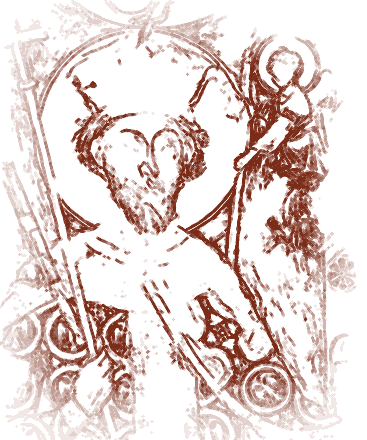
Constantine the Philosopher, in the Life that he wrote, records that after his falling asleep Despot Stefan was buried in his endowment, that is, in the monastery of Resava - Manasija,
namely in the monastery's Church of the Holy Trinity [ŽDS 52, 87]. Although this church is mentioned in the historical sources as the burial place of Despot Stefan, the suffering fate of Manasija Monastery in the time of the Turkocracy turned this holy place into a military installation and a stronghold of people of another faith, which endangered the cherishing of the memory of the Holy Despot. The discontinuity in the historical existence of Manasija Monastery, the seizure and extinction of this monastery, not only prevented any possible development of the veneration of Despot Stefan as a saint, but also clouded the memory of the exact place of his repose.
During the dark centuries under the rule of the Ottomans, the church of Manasija Monastery was used as a military and economic facility, as a storehouse, as a stable for housing livestock, perhaps even as a mosque. Generations passed who, despite such circumstances, nevertheless kept the memory of Manasija Monastery as a holy place, but the monastery complex for a long period did not have its sacred function. It would be reasonable to suppose that neither the people nor the clergy, at the time when Manasija Monastery was used as a military and strategic installation, could even have had access to the occupied holy place.
It is not surprising that in such circumstances, to which pogroms and mass migrations of the population were added, not only was there no continuity in the veneration of Despot Stefan, but the memory of the exact place of his burial was lost. Thus the cult of Saint Despot Stefan, for certain reasons, did not flourish in the Serbian lands, while the exact position of his resting place vanished from the consciousness of the Church and the people. Nevertheless, the memory of Manasija Monastery as the place of his grave was preserved.