


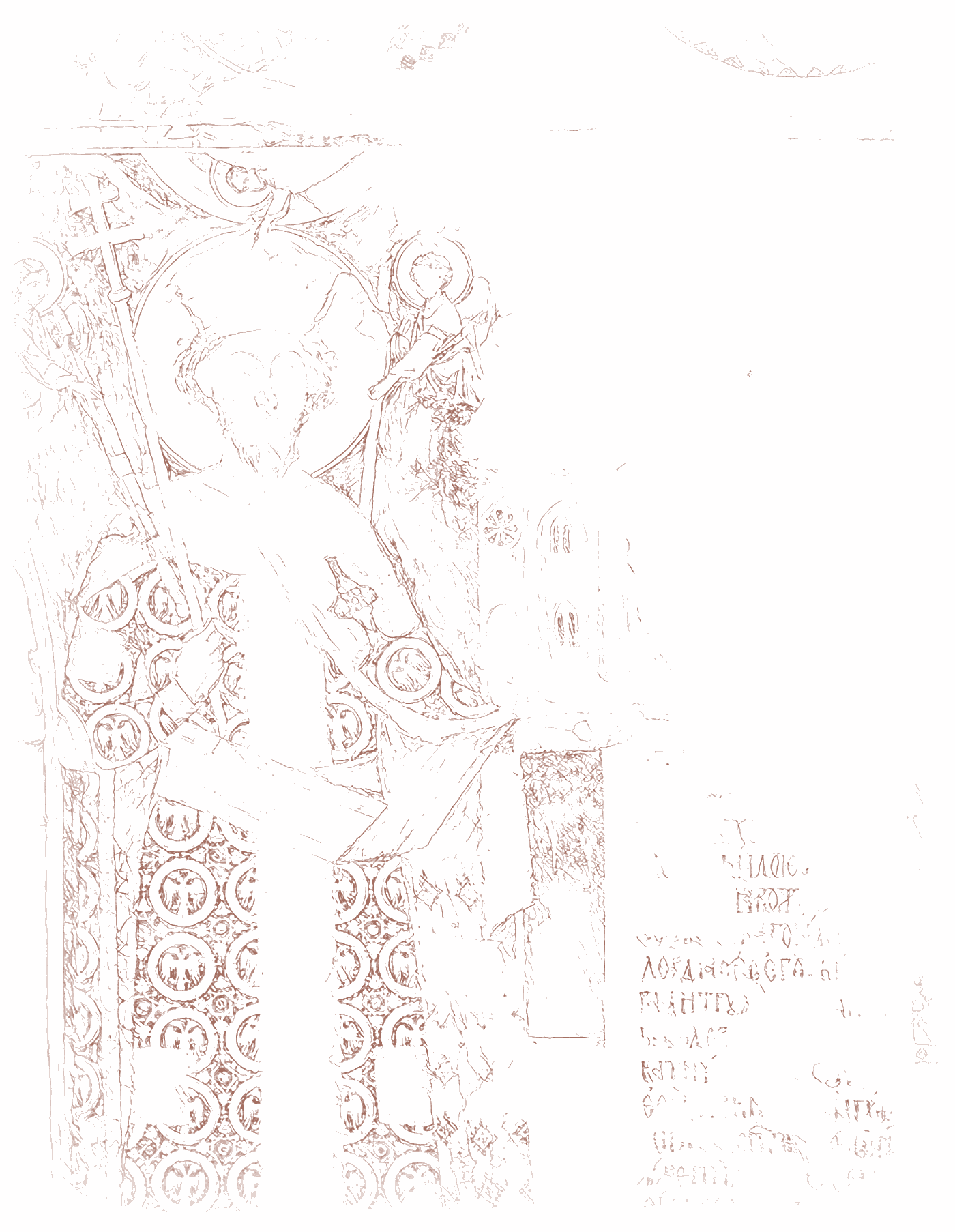
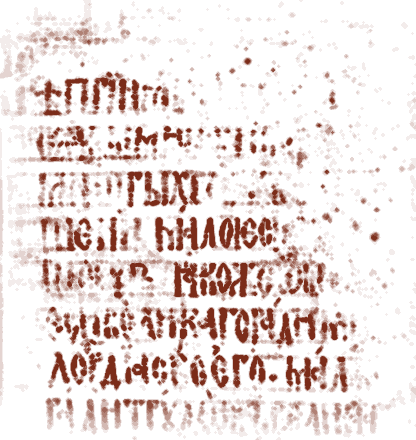
His other works, too, are recognized as exceptional; the Inscription on the Marble Pillar attributed to him, and his charters - which are at bottom formal and official acts, legal and diplomatic material - are true poetic works, like the Charter to the Despotissa Eupraxia
of 1405, or the Charter to the Monasteries of Tismana and Vodița of 1406,
or the Charter to the Monastery of Mileševa of about 1413, or his charters to the monasteries of Mount Athos - to Hilandar, the Great Lavra, Vatopedi, the Monastery of Saint Panteleimon, and so on - and it is therefore no wonder that these documents have been published so many times and in so many places, the most complete collection to date being the one edited by Academician Aleksandar Mladenović (1930– 2010). The documents produced during the reign of Despot Stefan testify to his learning and to his great engagement in building and preserving the cultural heritage.
Despot Stefan Lazarević was one of the most important patrons of art, culture and education in Serbian history. His vision of spiritual and cultural development was reflected in the support he gave to education, learning and culture in general. Stefan himself was exceptionally educated: he received a thorough education within his family. He wrote in Serbian Church Slavonic, and he also had command of Greek and knew Latin. Such a ruler, by his care, made possible the cultural upsurge of the Serbian Despotate, and also of the Serbian lands and the Serbian people in general. During the reign of Despot Stefan, Serbian literature experienced a flowering. In the words of the historian of Serbian literature Jovan R. Deretić (1934–2002), Serbian literature "had a period of brilliant renewal in the time of Despot Stefan, which would bring perhaps the greatest expansion of medieval literary activity." Prominent in this period are writers such as Constantine the Philosopher, who wrote the Life of Despot Stefan, and Gregory Tsamblak (c. 1360– 1420), a distinguished writer and preacher. Besides literary works, of particular importance was the copying activity that developed in the Resava copying school, founded in Manasija Monastery, the Despot's endowment. This school was one of the most important centers for the preservation and dissemination of culture and spirituality, copying
both Christian texts and the capital works of ancient civilization. The significance of this school was exceptional; certain researchers put forward the supposition that during the period of the Despot's reign more important texts were copied than in all the preceding centuries combined. By this work Stefan Lazarević built a spiritual shield for his people, leaving behind him a wealth that rested on the foundations of Christian civilization. His awareness of the importance of linguistic memory for the preservation of historical remembrance was deep and far-reaching. Thanks to his efforts, future generations found in this heritage a source for their spiritual growth and progress. In short, Despot Stefan, by his deeds and by his support of culture, left a deep and lasting influence on Serbian history, laying the foundations for the development of spirituality and art in later centuries.
The Despot was also a patron of monasticism [ŽDS 52, 76], a founder of churches and monasteries, a provider for the poor [ŽDS 51, 76]. The wise ruler cared for the common good. As Jovanka Kalić observed, by his reconciliation with his nephew Đurađ "Despot Stefan succeeded in establishing unity in the state. The establishment of internal peace also created more favorable conditions for the activity of the Serbian Orthodox Church." Great is the number of the Despot's endowments, or of those that came into being during his reign. In the spirit of the tradition of his forebears, Despot Stefan Lazarević showed exceptional generosity toward monastic communities and monasteries. He was the founder of numerous churches and monasteries, and the writings of monks of that time testify to his magnanimity and his spiritual contribution. His most important endowment, Manasija Monastery, represents the summit of the architecture of the Morava School. The church of Manasija Monastery is one of the most beautiful churches of the Serbian Middle Ages. Its dimensions are grandiose - only the Church of Christ Pantocrator of the Dečani Monastery is taller. Its white-marble appearance recalls the Romanesque treatment of the Raška style, while the floor of white and red marble, which can be seen especially in the narthex, is a masterpiece that by its beauty ranks alongside the pavement of the endowment of the Serbian Emperor Stefan Uroš IV Dušan (c. 1308/1312–1355), the Church of the Holy Archangels near Prizren. Not only a spiritual center, Manasija Monastery also became a cultural center, the home of the Resava copying school, which played an important role in fostering and preserving the literary heritage and in spreading literacy; by its architecture, its frescoes and its artistic values, Manasija is a symbol of the Despot's time and of his vision of leaving a lasting contribution to Serbian culture and spirituality.
In a few words, the Serbian medieval lands, in the twilight of their historical existence, shone forth with heights of culture and art, leaving behind them traces worthy of admiration. In architecture the Morava style flourished, recognizable by its elegance and lavish beauty, where the churches and their frescoes bore witness to the deep spirituality and artistic excellence of the age. At the court of Despot Stefan Lazarević, one of the most enlightened rulers of Serbian history, the renaissance of Serbian literature sparkled into being. The Despot himself, poet, warrior and thinker, was not only a patron but also an active creator, inspiring his contemporaries to raise word and thought to uncommon heights. His court, illumined by Eastern Roman learning