



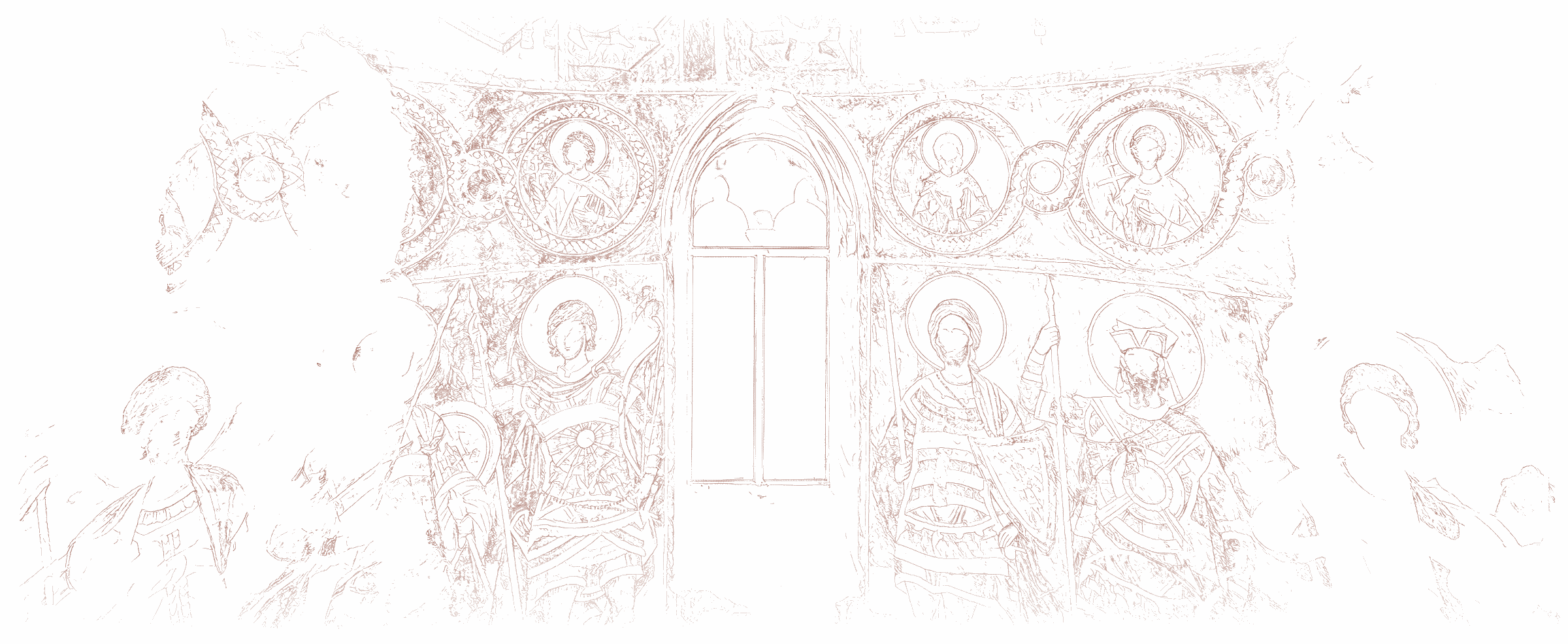
Despot Stefan Lazarević
The Life of the Holy and Right-Believing Stefan the Tall, Despot of Serbia
Page 3 of 44
and of the other chosen men, we agreed to labor (at writing the Life), since such was the time then. In the fourth year after his (the Saint's) passing to the Lord he himself appeared, and threatened as with punishment that I would be guilty if I did not fulfill that command. After that again, when I was with all my household in sojourn in a foreign land, he came into my house, to me who was unworthy to receive him, and commanded me to fulfill the promise. Therefore, even though I am not able to do it, I nevertheless strove to set forth his holy life and labors." And then, at the end, Constantine humbly adds: "If there are some who know better the life and deeds of Stefan and who were longer his companions, and are very learned and discerning, then that is truly good. But if to this day no one has taken the trouble, and in this our writing finds some shortcomings or something that is unnecessary and coarse, then let him, according to the command and in proper manner, set it all in order in its place. And we, as a chronicler, have written this as his Life together with all the other matters and events of that time." This biographer of the holy Despot Stefan, the learned man of letters and chronicler Constantine the Philosopher, was born in Kostenets in Bulgaria. He spent his childhood in Tarnovo, in the school of Patriarch Euthymius, and after the Turkish conquest of Bulgaria he came as a young man to Serbia (around 1411–12), where he continued his studies with the Serbian Patriarch Kirilo. From then on he lived mostly at the court of the holy Despot Stefan in Belgrade, and there he came to know very well the God-pleasing life and labors of this Righteous man, and came to know also "what kind of land it is that nurtured him (the Despot)." For the holy Despot Stefan and the Serbian land received Constantine, though a foreigner, as one of their own kin and household, as their brother and son. Therefore Constantine in the Life greatly praises both Saint Stefan and the Serbian land. The Despot, he says, was such a glorious ruler and so well-pleasing to God that "although chosen vessels flourished in many barbarian (i.e. non-Greek) lands, in whom the Lord with the Father made His abode (cf. John 14:23), yet they did not shine in human deeds as did this one." "This blessed Stefan," Constantine continues, "shone forth from the land of Dalmatia - Dacia, the land of those now called Serbs, where many have flourished in these latter times. And this land, that is, Serbia, is such that not only does it, like that promised land, flow with honey and milk, but it is as though it had received and bound within itself the four times (i.e. seasons) and the air, and then dispenses them from itself to others. For in the whole inhabited world no land can be found that has all good things gathered into one and on all sides, as this one has, since lands usually have only some good things and only in some places. But this Serbian land is full of every good thing, and has good air and a harmonious composition in all things. And since a tree is known by its fruit and a man by his deeds, by fruit and by deeds shall we too describe this land. First of all one must mention its gold and silver, for their sources, that is, the mines, are precious and rich, and it is as though they grow ever more the more they are drawn upon. And where in the east and the west can such and so great wealth be found? Truly nowhere. Likewise in this land many vineyards are planted, which nowhere as in this land, without great labor, abound in seed, in planting and in fruit. There are the springs of rivers and wells, and the harmony of one region with another, and images of beauty, so that some regions surpass others in loveliness and fruitfulness. And when winter and foul weather leave the land and summer draws near, the air is then well tempered and fair, as someone truthfully said, that he had seen very much of the world but that nowhere could better be found. It is needful to say something also about the birds and about all else that