

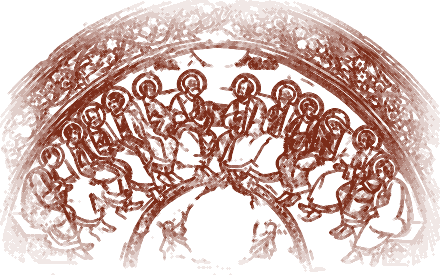
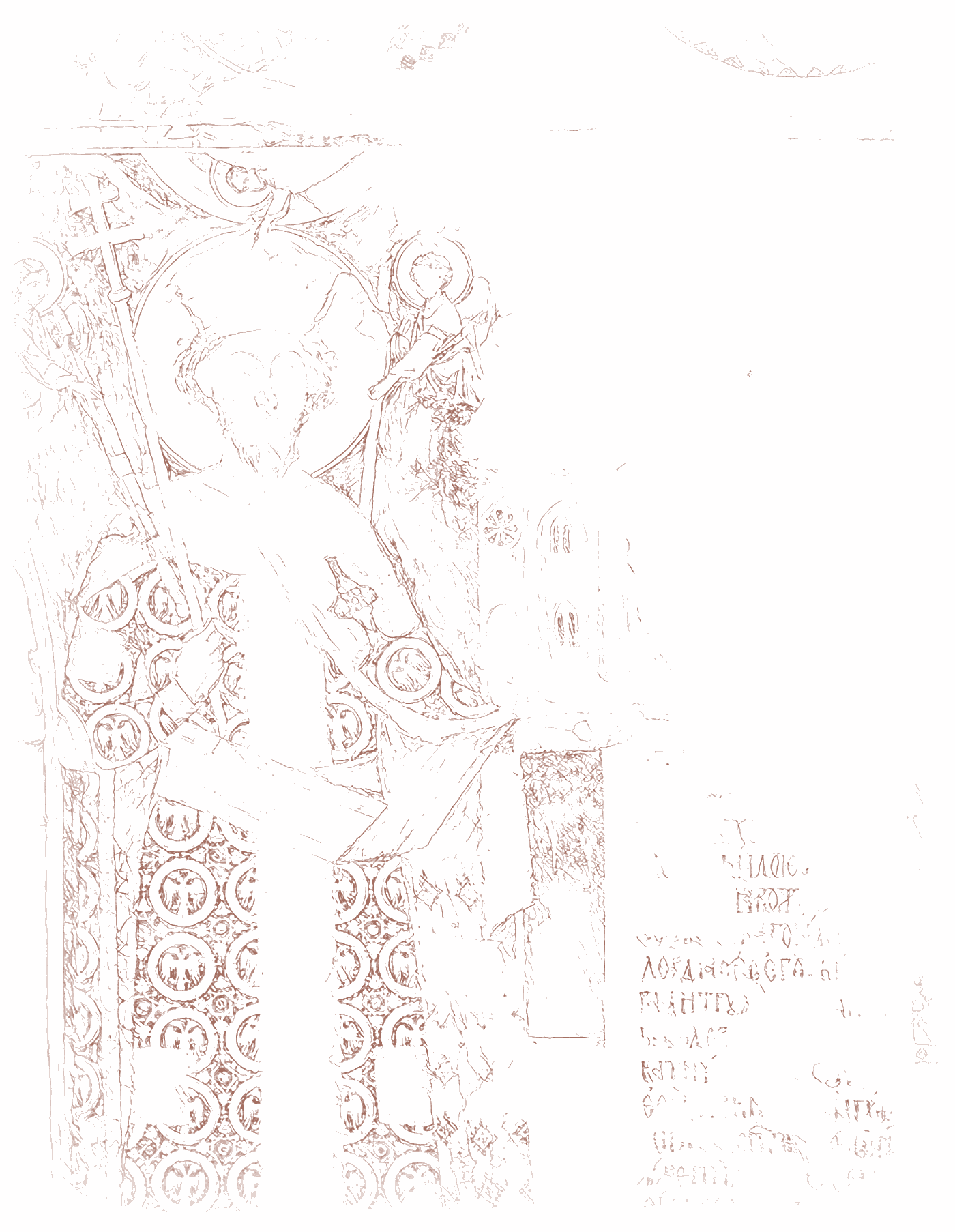
other leading figures of Church and state to the consecration of the church, organizing in full a magnificent celebration of the feast of Pentecost.
Finally, it was right there, in the Church of the Holy Trinity, that the Despot prepared a tomb for himself, in which he was laid some ten years after the completion of the building of the monastery.
These details about the founding and building of Manasija Monastery, which in choice and forceful words convey the significance and importance both of the monastic city of Resava and of its founder, seem to have a twofold purpose. On the one hand, these words seem to encourage the inhabitants of Resava, reminding them of the great responsibility they bear as monks of Manasija. On the other hand, there is also the basic function of these words - to be a praise of the founder of Resava, the benefactor who did everything to raise the Resava monastery; who, in the end, rests in his endowment.
It is possible that the special significance given in the Life to the Resava monastery as the Despot's burial endowment was meant to encourage and support his cult. The short prologue Life, which could have served as a confirmation of the sanctity of Despot Stefan, could have been extracted for liturgical use on the occasion of the uncovering of his relics. However, many troubles, such as the attacks of Murad II and the taking of Belgrade by Sigismund of Luxembourg, disrupted the life of the Serbian Despotate as a whole, and of the monks of Resava in particular: as early as 1439 Sultan Murad captured the Resava fortress [SSRL 660g; HSV 53].
Despite all the difficulties and the danger of war, the Despot's burial was carried out according to his testament; according to the Life, the Despot was mourned by all - Despot Đurađ and the nobles, priests and monks, the lords, officials, the army and the people. On the other hand, in the text of the Life the omission of any mention of Despot Đurađ among those who commissioned this text is noticeable. Constantine reports that he received the command to write the Life from Patriarch Nikon, "the military commander and (from) the other chosen ones" [ŽDS 92]; it is striking that Despot Đurađ is not mentioned. It is possible that Despot Đurađ did not support the cult of Despot Stefan; in any case, traces of the veneration of the Despot as a saint point to the existence of his cult in the twilight of Serbian statehood.
However, no clear mentions of the Despot's cult have been preserved; this, on the other hand, does not mean that it did not exist - it may have been stifled in the years of oppression and repression. A Turkish military garrison was stationed in the Resava monastery in 1439–1444; for a short period the monastery was returned to Serbian hands, but in the Ottoman campaign of conquest it was plundered already after 1455; according to the Bijelo Polje Chronicle, in the year 1456 the Resava monastery burned [SSRL 710]; in the year 1458 the Resava monastery was taken by the Ottomans, and the monastery was soon turned into a military installation. The fact that the Resava monastery was left without monks very soon after the Despot's repose explains why his cult did not develop more strongly. Still, the cult of Saint Despot Stefan did not disappear - it was carried to Russia and some other lands, most probably through migrations, nor was it forgotten in the Serbian regions: the Serbian monks Damjan and Pavle