



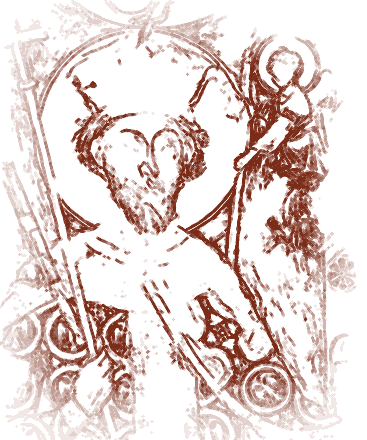
Despot Stefan Lazarević
The Mining Law of Despot Stefan
Page 5 of 11
Mining Law itself. Radojčić also published a discussion of other existing manuscripts of this legal act, seeking to shed light on the historical circumstances of its origin and application. The edition also includes a specialized glossary of mining terms that were in use among the Saxons, the mining people who played a key role in medieval Serbian mining production. As a supplement, the edition also contains a reproduction of the original manuscript in 26 illustrated plates.
The Serbian Academy of Sciences and Arts has published a translation of this Code into modern Serbian prepared by Biljana Marković. Since mining production revived in the 16th century in the territories of the European part of the Ottoman Empire, this code became significant beyond the Serbian lands as well. For precisely this reason, the Mining Law of Despot Stefan Lazarević was translated into Turkish and adapted to the needs of the Ottoman Empire under the name of the Saxon Code; thus, even after the fall of the Serbian Despotate, in the period of Turkish rule, the Despot's code regulated mining activities in Novo Brdo, Kratovo and other important mining centers. Fehim Spaho (1877–1942) published the Turkish translation of this law in 1913, at the same time translating it into Serbian.
The Mining Law of Despot Stefan Lazarević
Preface to the Mining Law
The Law of Stefan the Despot, right-believing and Christ-loving among emperors, on guilds and on hereditary holdings and on faith and on wheels and on all necessary courts.
By the ineffable love for mankind of our Lord Jesus Christ, and of His all-immaculate Mother, our Lady and Theotokos and Ever-Virgin Mary, and by the prayers of my holy lord and father, Prince Lazar, I, his offspring, Despot Stefan, ruled after his death in the land of my fatherland. Then came the onslaught of the foreigners against the Christians. Seeing so great a victory over the land of my fatherland, I took counsel from the patriarch, kyr Spiridon, and from the other hierarchs, and from my mother, Princess Milica, called in monasticism the nun Jevgenija, and from the whole assembly, and I went to the eastern parts, to