



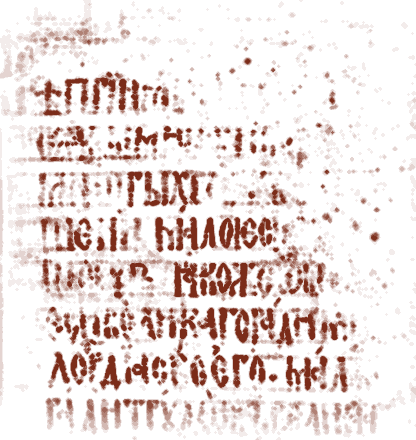
nâshâh, "to forget", that is, "to cause to forget" (reference H5382 in Strong); in the traditional understanding, this name is taken to be etymologically connected with the remission of sins that repentance implies. In the original text of the New Testament, this name reads in Greek Μανασσῆς (reference G3128 in Strong's Greek Dictionary of the New Testament). Interesting is the meaning of a word that sounds exactly the same in Sanskrit (as well as in Hindi, in the Dravidian languages and in Nepali), where this word (Manasija - मनिसज) is a noun, and can mean love, as well as that which is born in the mind or heart - of the mind, of the spirit and of the heart. Manasseh, however, is the name of yet another notable biblical figure - the firstborn son of Joseph and Asenath (cf. Gen. 41, 50–51; 46, 20; 48, 18), who was adopted by his grandfather, the Forefather Jacob (cf. Gen. 48, 1–20), that is, the name of the progenitor of one of the twelve tribes of Israel, namely the tribe of Manasseh (cf. Num. 1, 34–35; 26, 28–34; Josh. 13, 29– 31; Rev. 7, 6); certain authors have supposed that the epithet of Saint Despot Stefan was connected with this Manasseh, that is, that the name of the biblical
progenitor of one of the Hebrew tribes also became the name of the monastery of Resava. Thus the Serbian art historian, the academician Svetozar Radojčić (1909–1978), noticing that Constantine the Philosopher in the Life of Despot Stefan passes over the name of the monastery in silence, asserted that its name was already Manasija at the time of construction. Radojčić puts forward the supposition that the name Manasija was given to the Resava fortress in accordance with the practices and customs of the time; moreover, he considers that this name expresses the unity of the monastery church and the fortress. Explaining his thesis, Radojčić writes: "The name Manasija is entirely in the spirit of the Western naming of fortresses of that time. In France, too, there is a Manasija: Tour de Manassès de Garlande. The allusion to the name of the Old Testament Manasseh, son of Joseph, is evidently connected with those passages in the Book of Joshua that speak of the building of a great altar on the border of Canaan, on the bank of the Jordan." Other authors later also referred to Radojčić's thesis; this supposition, however, offers no explanation of why the Holy Despot is called a second Manasseh for his "sweetness of speech". This ornamental epithet could, however, be connected with Constantine Manasses, that is, with the person of a medieval Eastern Roman writer of the 12th century (Κωνσταντῖνος Μανασσῆς, c. 1130–1187), author of the very popular Chronicle, translated into the Slavic languages as early as the middle of the 14th century, a man of letters and later a bishop, and finally Metropolitan of Naupactus; but again it is not clear whether the translator of the Books of Kings compares Despot Stefan Lazarević with this famous writer; in the literature, at any rate, various explanations are encountered. The jurist and literary historian, the academician Andra Nikolić (1853–1918), held that Despot Stefan was called Manasseh precisely after this Eastern Roman author of the 12th century. He also held the opinion that the name Manasija for the monastery of Resava is ancient. Nikolić writes: "Knowing, therefore, that Despot Stefan Lazarević was already in his lifetime called a second Manasseh, and bearing in mind that he raised Resava, in which he is also buried, we shall understand why his endowment was named Manasija. Here, as can be seen, the honorific name of the ktitor and founder passed to his endowment, probably in connection with the commemoration of his grave.