

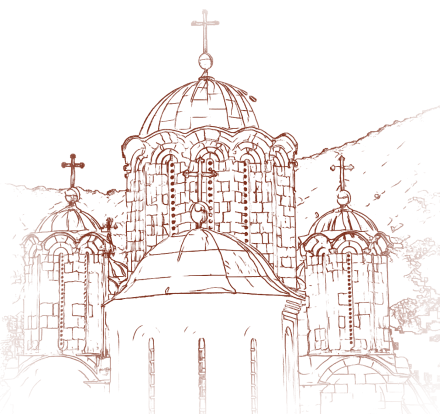

Hilandar Chronicle), with his see in the Resava Church of the Holy Apostles, that is, of the Holy Apostles Peter and Paul (as recorded in the Vukomanović Chronicle and the Sjenica Chronicle) [SSRL 469; SJ 177]; the same manuscripts, in tenth place, also mention the bishop of Braničevo - which would mean that in the first half of the 13th century two Serbian eparchies were active in the Resava district; here, however, we are dealing with a copyist's error, by whose mistake the bishop of Resava is mentioned instead of the bishop of Ras. Two more old manuscripts - the Janko Chronicle and the Dečani Chronicle - mention the Resava region as a center of church life in the period before the reign of the holy Despot: according to these two manuscripts, the holy Serbian King Stefan Uroš II Milutin Nemanjić (c. 1253–1321) raised, among his endowments, the Church of Saint George on the Resava [SSRL 514]. These mentions, however, should be read critically, since they are copyists' errors - in this second case, the copyist mistakenly wrote that the endowment of the holy King Milutin on the (river) Serava (near Skopje) was located on the Resava. Yet the very mention of the Resava region in these manuscripts, on the other hand, does point to the particular importance of the district of the monastery of Resava in the church context. In surroundings already adorned with churches and monasteries, when at the beginning of the 15th century somewhat better circumstances arose both for the Serbian people and for the Serbian Church, Despot Stefan Lazarević, having succeeded in restoring the Serbian state and gathering most of the Serbian lands under his rule, builds his endowment in Resava. The beauty of Manasija Monastery, adorned by its central edifice, the Church of the Holy Trinity, captivates and takes one's breath away even today. So extraordinary is the beauty of this church and of Manasija Monastery that in the century before last the renowned German travel writer and archaeologist Felix Kanitz (1829–1904) records that it was “the most remarkable building in Serbia, and perhaps in Europe,” which was later repeated by Sava Bjelanović (1850–1897) and Radoslav Grujić (1878–1955). When one takes into account the circumstances in which this monastery was raised, together with the fact that it surpasses the other buildings of the epoch in which it was created, on the one hand in its architecture and art, and on the other in its splendor and monumentality, this feat of the holy Despot Stefan, this unique monument and singular testimony to the artistic and architectural achievements of the Serbian Despotate, arouses admiration. At the beginning of the 15th century the eastern parts of the Serbian Despotate, especially east of the Morava River, on its right bank, were a monastic refuge. Monks had been arriving in these parts since the time of the holy Prince Lazar; renowned are the many Sinaites with whose activity the still active and living monasteries of Braničevo and the Morava valley are associated. It seems that in the time of the holy Despot Stefan there was also a significant growth in the monastic population. Several new monasteries were raised in the lands under his rule. The raising of the monastery of Resava (Manasija), which Despot Stefan conceived as a spiritual and cultural center, was a great architectural and artistic undertaking. The holy Despot Stefan Lazarević deeply esteemed monasticism. Constantine the Philosopher, in the Life of Despot Stefan, states that the Despot rejoiced at meeting hermits, received them with tenderness and considered them more precious than any
Manasija Monastery · Imperial Lavra of the Holy Trinity
Manasija
loading the page