


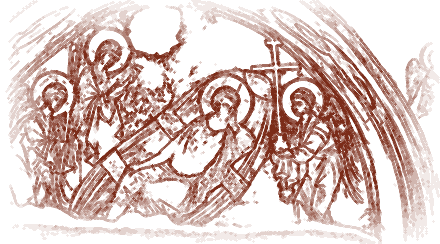
Theotokos with Christ; the Theotokos raises both hands in prayer, while Christ, before her breast, blesses with both hands outspread. It is supposed that the frescoes in the lunettes above the entrances from the narthex into the nave of the Church of the Holy Trinity at Manasija are the work of a company of icon painters, followers of David of Selenica, who, after successfully completing their work in the Church of Saint Demetrius in Bitola, continued their artistic mission in the Metropolitanate of Karlovci of that time, where they were engaged in important projects, among which stand out the painting of the restored church of Vojlovica Monastery near Pančevo around 1732, and of the newly built church of Drača Monastery near Kragujevac, which they painted in 1735. These painters were invited to adorn with their skills the restored narthex of Manasija Monastery as well, also completing this work in 1735. Their work represents an important union of the traditional icon-painting heritage and the artistic innovations of that age. Around these lunettes and on the door jambs spreads a wealth of floral ornaments, which with their vivid beauty bring the space to life and connect it with the spiritual heritage of past centuries. This decoration is a symphony of colors, forms and light, preserving the spirit and majesty of ancient art despite turbulent historical circumstances. The decorative system of the painting of Manasija Monastery was conceived and executed in exceptional harmony with the architectural forms of the church, like a symphony in which architecture and art merge into a perfect unity. The buildings in Serbia shaped by the masters from the Littoral, with their simple and well-considered spatial structure, called for a logical and harmoniously organized arrangement of the frescoes. The masterfully and very precisely and carefully finished, sound stone walls of the church were an ideal ground for painting, making possible complete harmony between the architectural lines and the painted ornament.
The Iconostasis
The original iconostasis of the Church of the Holy Trinity at Manasija has not been preserved. Throughout its history, Manasija Monastery was turned into a military complex during the period of Turkish rule and during periods of suffering, while the church served as a stable, as a storehouse, as a utility and auxiliary building... In this sense it is not only no wonder that the original iconostasis has not been preserved, but it is a true miracle that Manasija withstood so many misfortunes and survived. In the descriptions recorded during the 18th century by the exarchs Maksim Radković and Jovan Mihailović, in the period of the short-lived restoration of Manasija Monastery, mention is made of icons